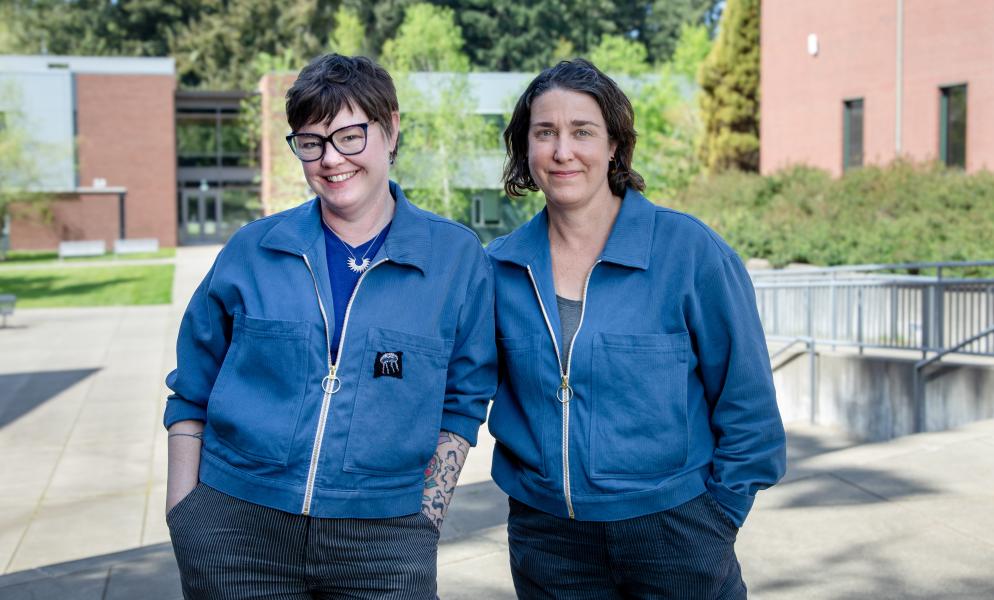
They called the workshop series “Joyful Practice for Dark Times”. What began as an eight-week Zoom workshop quickly grew into something larger. As Berney and Tavis facilitated sessions, they began noticing recurring ideas emerge: the role of play, and the relief that comes when creativity is treated as exploration rather than performance.
Those ideas eventually became the foundation for The Joyful Practice Handbook: analog play for dark times, a handmade, illustrated guidebook designed to support ongoing creative practice. The book is intentionally unplugged—typed, drawn, and assembled by hand—and invites readers to step away from screens and return to tactile creative processes.
Rather than offering one-off prompts, the handbook introduces what Berney and Tavis call “Joyful Practices”, adaptable activities readers can return to over time. It also includes short essays on the creative process and a series of illustrated guiding principles that reflect the evolving philosophy behind the work. One of the book’s most playful elements is the inclusion of “Guardians,” archetypal figures ranging from mythological characters to contemporary artists, meant to spark imagination and invite new perspectives. The book is set to release in September 2026 and is printed by Gorham Printing, a longtime collaborator who previously printed editions of SPSCC’s literary and arts journal, the Percival Review (now known as South Sound Review).
While the concept of Joyful Practice has reached participants both locally and beyond Olympia, its roots are firmly grounded in the community where both writers have lived and worked for decades.
“I think there’s a funny combination of local interest and the fact that, when you lead a workshop on Zoom, truly anyone can come,” Berney laughed. “But we’ve mostly wound up hosting our broader Olympia community.”
Tavis agreed, noting that long-standing relationships made the project feel less intimidating to launch. “I’ve been in Olympia since ’97,” she said. “There’s a group of artists and writers we’re already connected with and building that community maybe felt more possible because of that.”